
US IP in Japan? How IPTV Beats Geo-Blocks for Live Football and Global Sports
Japan is one of the best countries in the world to live in — and, if you're a sports fan with a foreign passport, one of the most frustrating. The Champions League kicks off at 4:00 a.m. Tokyo time. The Brasileirão final lands on a Tuesday lunch break. And when you finally sit down to watch, a screen politely informs you: "This content is not available in your region."
That's exactly why so many people end up on usip4japan.com in the first place — hunting for a US IP address, a VPN, a workaround, anything to unlock the streams they used to watch back home. But here's the truth most geo-unblocking guides never tell you: changing your IP address doesn't give you channels. It just changes your address. If you want live football, live F1, live UFC and 12,000+ channels in 4K — without the VPN gymnastics — you don't need a different IP. You need a proper sports-focused IPTV service.
What Is IPTV — and Why It Beats a US IP Address for Live TV?
IPTV stands for Internet Protocol Television. Instead of a satellite dish, a cable box or a rented router full of VPN tunnels, IPTV streams live channels and on-demand content directly to your device over your existing internet connection.
Think of the difference this way:
- A VPN or US IP = a disguise. You pretend to be in New York so a streaming app stops blocking you. You still need a paid account with that platform, and you still get one platform's catalogue.
- IPTV = a delivery truck. You get the actual channels — Brazilian, Argentine, Portuguese, Japanese, American, European — delivered to your screen, wherever your router happens to be plugged in.
For anyone living in Japan, that's a game-changer. No more stacking three subscriptions, no more VPN servers dying mid-match, no more "region locked" error screens. Just one app, one playlist, and every competition you care about.
Why IPTV Fits Life in Japan So Well
Japan has some of the fastest residential internet on the planet. Fiber from NTT Hikari, au Hikari, SoftBank Hikari and NURO routinely delivers 1 Gbps. Even a decent 5G pocket Wi-Fi handles 4K without breaking a sweat. In other words: the infrastructure for flawless IPTV already exists in your apartment. You've just been using it to buffer through VPNs.
How IPTV Solves the "US IP in Japan" Problem for Sports Fans
If you landed here looking for a US IP, your real goal probably wasn't an IP address at all. It was one of these:
- Watching live football that's blacked out in Japan
- Following your home league — Brasileirão, Liga Argentina, Liga Portugal, La Liga, Premier League
- Getting sports commentary in Portuguese or Spanish instead of Japanese
- Not paying for five separate streaming subscriptions
- Not explaining to your family why the screen froze again at 2-2
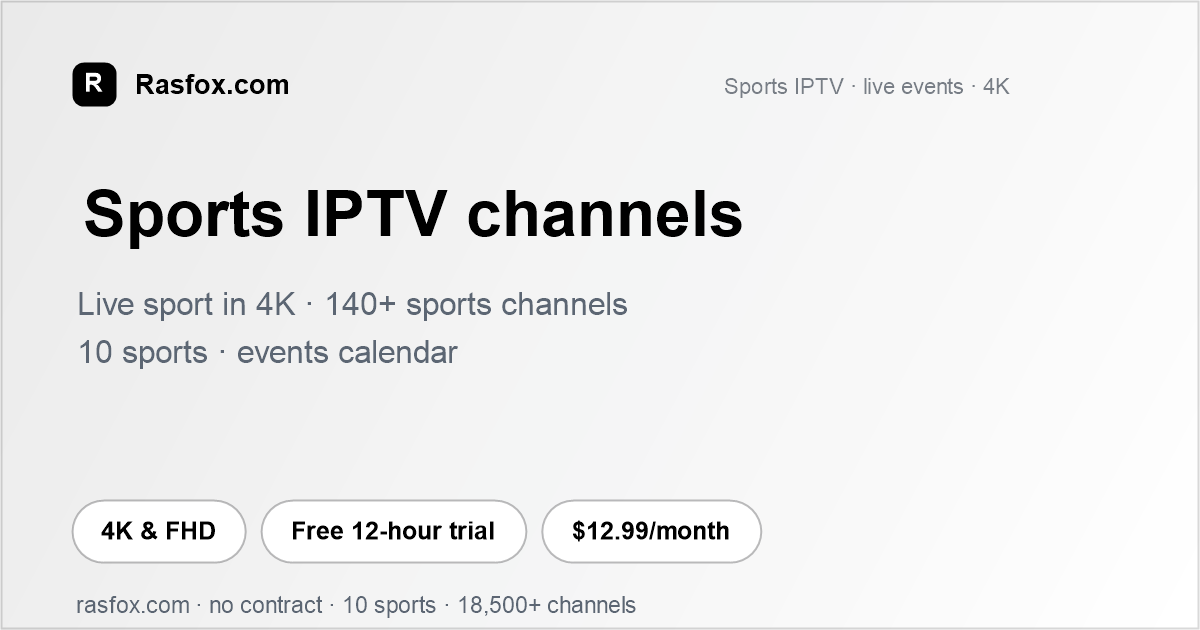
IPTV checks every single box. A sports-focused IPTV subscription on RasFox.com bundles 12,000 live channels and 40,000 on-demand titles, with 4K 50FPS sports streams, into a single app. There's no IP spoofing, no VPN server list, no per-platform login. You open the app, you pick the match, you watch.
The Technical Reality: Latency vs. Buffering
Here's a detail most "US IP Japan" tutorials skip. VPNs add latency — often 40 to 120 ms — because your traffic is being routed through a server in Los Angeles or Seattle and back again. That extra hop is exactly what makes a stream stutter right at the worst possible moment.
A well-built IPTV service does the opposite: it uses optimized delivery nodes and adaptive bitrate so the picture does not buffer. When a provider advertises "sem travar / sin buffering / no buffering", this is what they mean — sports at 50 frames per second, where even a half-second stutter is visible on a fast counterattack.
The IPTV Landscape in Japan: What Expats Actually Watch
Japan is a fascinating IPTV market. Domestic broadcasting is excellent but heavily focused on local tastes: NHK, J Sports, Sky PerfecTV!, GAORA, DAZN Japan, Fuji TV, TV Asahi and TBS cover J1 League, NPB baseball, sumo and Japanese volleyball beautifully — and very little else.
Meanwhile, Japan is home to one of the largest Brazilian communities outside Brazil, plus sizeable Peruvian, Bolivian, Venezuelan, Filipino and Western expat populations. And that's where the demand explodes.
The Channels People in Japan Actually Want
A serious IPTV package for viewers in Japan should carry all of these — and the good ones do:
- Brazil: Globo, SporTV, Premiere, ESPN Brasil, BandSports, Combate, TNT Sports BR
- Portugal: Sport TV 1–6, Eleven Sports, Benfica TV, Porto Canal, DAZN Portugal, Eurosport
- Argentina & Latin America: TyC Sports, ESPN Premium, TNT Sports Argentina, Fox Sports, DirecTV Sports
- Japan & Asia: NHK, J Sports, GAORA, Sky PerfecTV!, DAZN Japan
- Worldwide: ESPN, DAZN, Fox Sports, beIN Sports, Sky Sports, Eurosport, SuperSport
And the competitions? Brasileirão, Copa Libertadores, Champions League, Premier League, La Liga, Liga Portugal, Liga Argentina, J1 League, Formula 1 and UFC — the full calendar, not a highlights package.
The Radio Malena 89.1 FM Heritage: Built by Sports People
This is where RasFox is different from the anonymous reseller sites you'll find on Reddit. Its roots trace back to Radio Malena 89.1 FM — broadcasting from Venezuela 370, Buenos Aires — a station steeped in tango, Argentine culture and, above all, football talk. That DNA never left.
Today, 80% of the RasFox IPTV catalogue is engineered around sports: live events, dedicated sports tiers, Portuguese- and Spanish-language commentary, and match-day reliability that was designed by people who actually get nervous during a penalty shootout. From Buenos Aires radio to lusophone and Latino households worldwide — including thousands of screens in Japan.
Hardware and Setup Guide for Viewers in Japan
One of the best things about modern IPTV is that you almost certainly already own the hardware. Setup takes about ten minutes.
Recommended Devices
- Amazon Fire TV Stick (4K / 4K Max) — the most popular choice in Japan, cheap and reliable
- Android TV boxes — best for 4K 50FPS sports and heavy channel surfing
- Smart TVs — Samsung Tizen, LG webOS, Sony Android TV all work with the right app
- Apple TV 4K — silky smooth interface, great for VOD too
- Smartphones & tablets — iOS and Android, perfect for the train commute or a lunchtime Brasileirão match
- PC / Mac — via VLC or a dedicated player
Internet Speed You Actually Need
- 15–25 Mbps — Full HD, stable
- 25–50 Mbps — 4K sports at 50FPS, no buffering
- Ethernet cable or 5 GHz Wi-Fi — strongly recommended for match days
For a full breakdown of device compatibility and streaming quality, you can check RasFox's 4K setup and device list before you commit to anything.
The Two-Screen Advantage
Most households in Japan don't have one sports fan — they have two, often supporting rival clubs. A good plan includes 2 simultaneous screens, so the Champions League can play in the living room while the Brasileirão runs on a tablet in the kitchen. No arguing, no separate subscriptions.
Legal vs. Illegal IPTV: Safety and Best Practices
Let's address the elephant in the room, because it matters — especially if you're a foreign resident in Japan thinking about contracts, residence status and peace of mind.
The legal distinction is simple: IPTV technology itself is completely legal. It's a delivery method, no different in principle from Netflix or YouTube. What matters is licensing — whether the operator has the right to redistribute the channels it carries, and how transparent it is about its service, payments and support.
Red Flags to Avoid
- No real website, no company information, no support channel
- Prices that are "too good" with no trial period offered
- Payment only via untraceable methods with zero receipts
- No Portuguese or Spanish support if that's your language
- Constant buffering and channels that vanish weekly
Green Flags to Look For
- A 24-hour free trial so you can test before paying
- No long-term contract — month-to-month flexibility
- Transparent pricing and clear device limits (e.g., 2 screens)
- 24-hour, PT/ES-speaking support
- A catalogue built around a specialty — like sports — rather than 30,000 random channels
If you want the safest, most transparent route, the sane recommendation is a provider that publicly stands behind its service and lets you test it first. That's precisely how the best IPTV service for live sports operates: free 24-hour trial, no contract, no buffering guarantee, and real human support in Portuguese and Spanish.
Why RasFox.com Is the Sports-First Choice for Viewers in Japan
Plenty of IPTV providers claim they're "the best". Very few are built around a single obsession. RasFox is.
- 12,000 live channels spanning Brazil, Portugal, Argentina, Latin America, Japan, Europe and the US
- 40,000+ VOD titles in 4K — films, series and full match replays
- 4K at 50FPS for live sports, because football deserves real frame rates
- 2 screens included with the standard plan
- No buffering — optimized servers for the Asian region, not just Europe and the Americas
- No contract — cancel whenever, no cancellation fees, no retention calls
- 24-hour free trial — test the Champions League before you spend a yen
- Support in Portuguese and Spanish — because talking about football in your own language matters
And behind all of it: the sports-first philosophy inherited from Radio Malena 89.1 FM, Venezuela 370, Buenos Aires. Tango on the radio, football on the screen, and now IPTV for lusophone and Latino communities across the world — Japan included.
Final Whistle: Your IP Address Was Never the Problem
If you came to usip4japan.com looking for a US IP so you could watch the football again, you were solving the wrong problem. An IP address is a doorman. IPTV is the entire stadium.
You live in a country with world-class internet, world-class screens and a massive international community hungry for home-league football. The only missing piece was a reliable, sports-focused IPTV service that doesn't buffer, doesn't tie you into a contract, and doesn't leave you alone at 4 a.m. with a spinning circle.
Test it before you trust it. Grab the 24-hour free trial, load up the Brasileirão or the Champions League on your Fire Stick, and see for yourself what live football is supposed to look like.
👉 Start your 24-hour free IPTV trial at RasFox.com — 12,000 channels, 4K sports, no buffering, no contract.
FAQ: IPTV and US IPs in Japan
Do I need a VPN or a US IP address to use IPTV in Japan?
No. IPTV streams over your normal Japanese internet connection. A VPN is only useful for accessing region-locked apps; IPTV delivers the channels directly, so you can skip the VPN entirely — and avoid the extra latency that causes buffering.
Can I watch Brazilian football like the Brasileirão from Japan?
Yes. A sports-focused IPTV package includes Globo, SporTV, Premiere, ESPN Brasil, BandSports and TNT Sports BR, so you can follow the Brasileirão, Copa Libertadores and Copa do Brasil live from Tokyo, Osaka or anywhere else in Japan.
How many devices can I use at the same time?
Standard RasFox plans include 2 simultaneous screens, which is enough for a living-room TV plus a tablet or phone. That means two matches at once — ideal for split-support households.
Is there a free trial, and do I have to sign a contract?
Yes, there's a 24-hour free trial so you can test live sports quality, channel selection and buffering on your own connection. There's also no contract — you pay for the period you want and cancel whenever.
What internet speed do I need for 4K sports without buffering?
Around 25 Mbps is the sweet spot for 4K at 50FPS. Japanese fiber connections (NTT Hikari, au Hikari, SoftBank Hikari, NURO) easily exceed this. For the most stable experience, use an Ethernet cable or a 5 GHz Wi-Fi band during live matches.
Is IPTV legal in Japan?
IPTV as a technology is legal — it's simply television delivered over the internet. What matters is whether the service you choose operates transparently, offers real support, and lets you test before paying. Always choose a provider with a public website, clear terms, a free trial and verifiable support.